
The Amazing History of Soccer: From Ancient Kicks to a Global Game
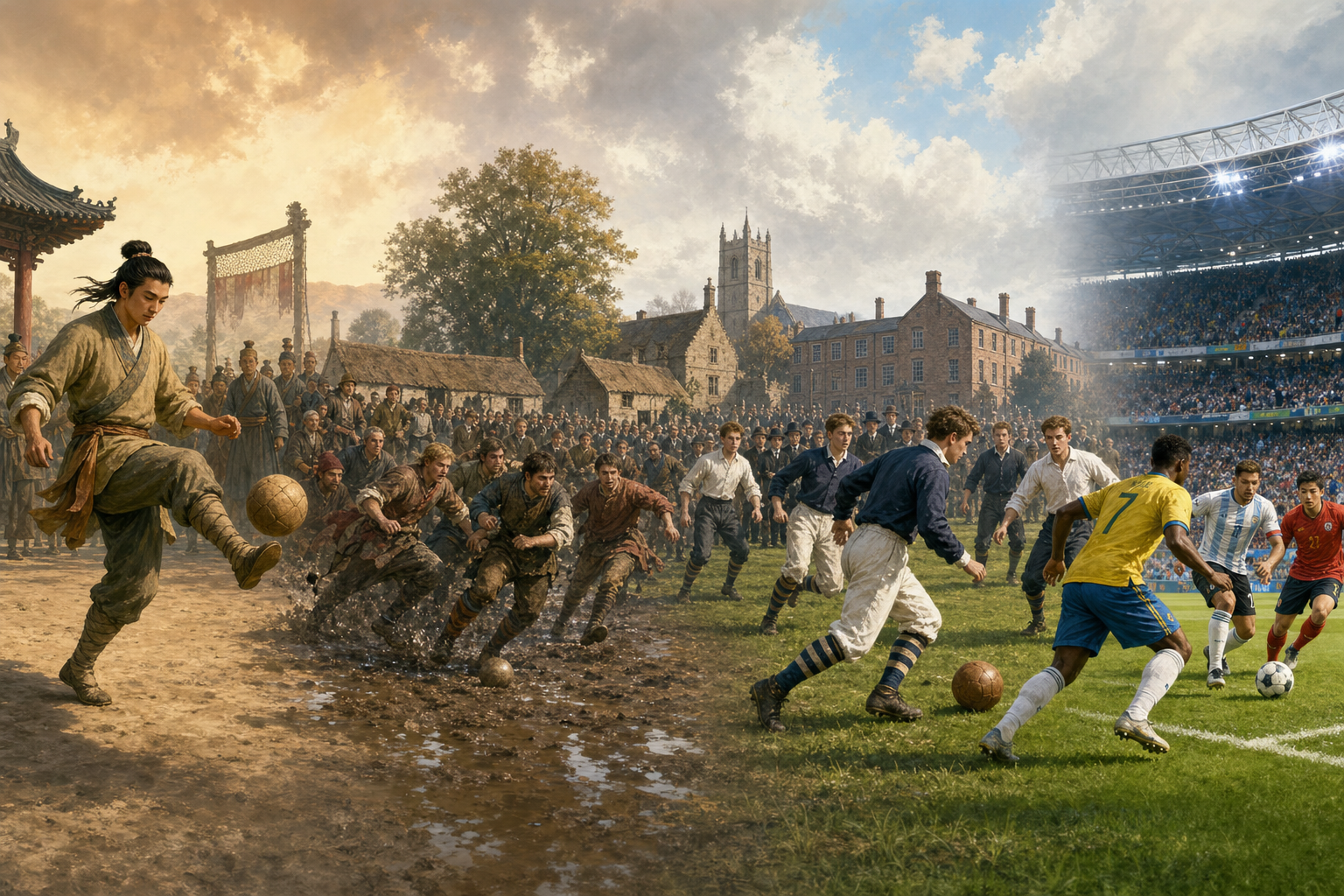
Imagine one game that can fill a giant stadium, stop traffic in a capital city, and make children celebrate on a dusty field with two stones for goalposts. That game is soccer—called football in most of the world.
Soccer looks simple: two teams, one ball, and a rule that most players cannot use their hands. But its history is anything but simple. It includes ancient training games, muddy village battles, school arguments, rule-making meetings, factory teams, radio broadcasts, brave women who refused to stop playing, and tournaments watched across the planet.
This is not the story of one inventor who suddenly created soccer. It is the story of many people, in many places, slowly shaping a shared game. So lace up your imaginary boots. We are going back more than two thousand years.
Chapter 1: Before Soccer Had a Name
Ancient people loved kicking games
Humans have played with balls for a very long time. Balls could be made from leather, cloth, feathers, hair, or an animal bladder. Different societies created different games. Some involved kicking. Others allowed carrying, throwing, or striking the ball. These games were relatives in a huge family, but they were not yet modern soccer.
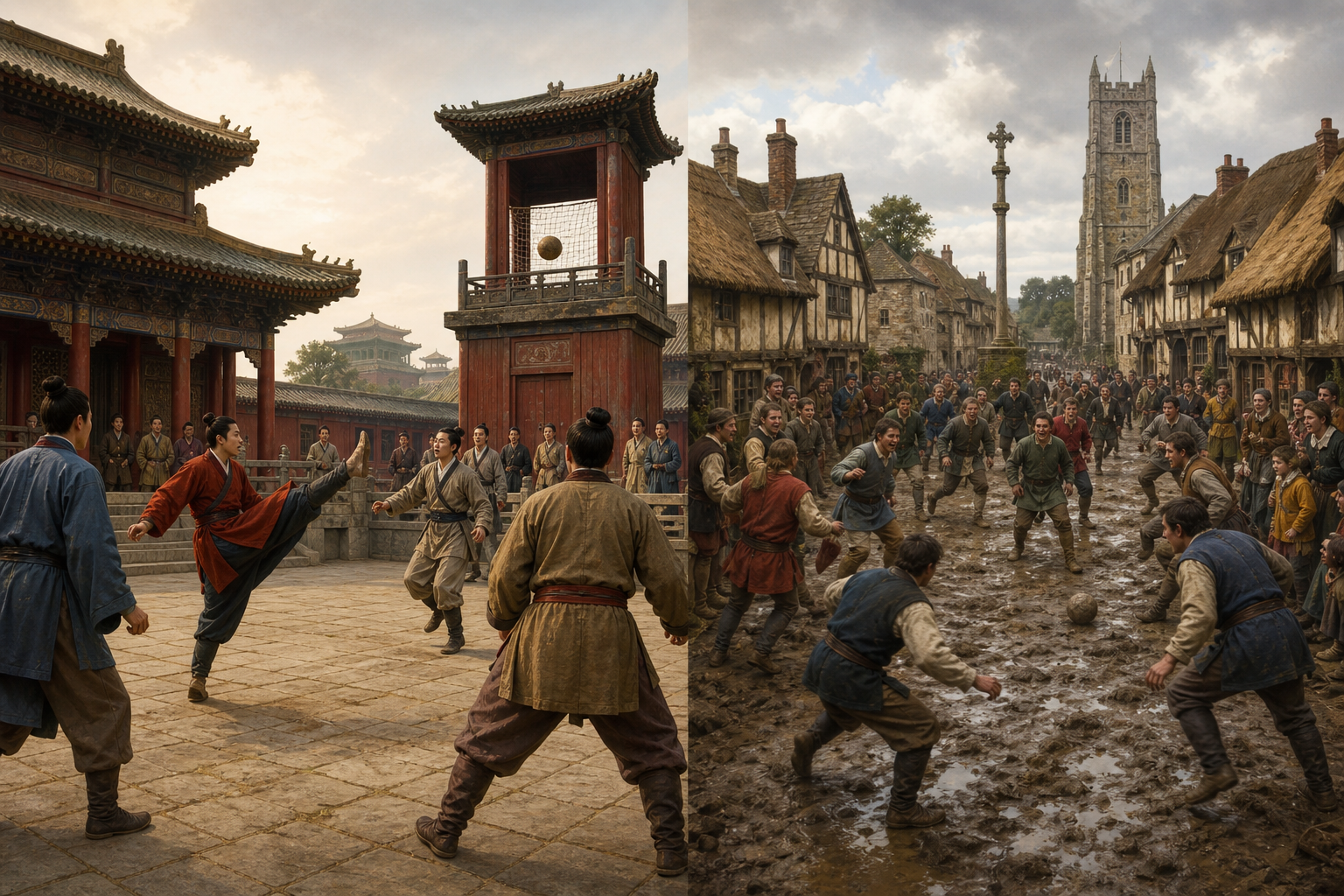
One of the best-known early kicking games was cuju in ancient China. The name roughly means “kick ball.” Written records describe it during the Han dynasty, more than two thousand years ago. Players tried to kick a leather ball toward or through an opening. In some forms, they competed in teams. In others, they showed skill and control.
Cuju could be military training, court entertainment, or a public game. Skilled players learned balance, accurate passing, and soft touches. Those ideas sound familiar to any modern midfielder. Yet cuju had its own rules and culture. Historians do not say that today’s soccer is simply cuju with a new name. It is better to say that cuju proves people enjoyed organized kicking games long before modern football appeared.
Ancient Greece had ball activities often grouped under names such as episkyros, and Romans played a rough game called harpastum. Much of what we know is incomplete. Pictures and short written descriptions survive, but a complete ancient rulebook does not. That is why careful historians avoid pretending that every old ball game was “the first soccer.”
From a ball to a tradition
The important idea is bigger than one country. People everywhere enjoy a challenge that mixes movement, teamwork, space, and a ball. A ball is unpredictable. It bounces badly, rolls away, and forces players to react. That makes a game exciting even when the equipment is simple.
Fun thought: If you gave a group of children a round object and an open space, how long would it take before they invented boundaries, teams, goals, and arguments about the rules?
Chapter 2: The Wild Football of Medieval Streets
By the Middle Ages, people in Britain and other parts of Europe played large folk-football games. These were not tidy matches on marked grass. A game might involve dozens—or even hundreds—of people. The “field” could stretch between two parts of a town. A bridge, church door, village boundary, or other landmark might serve as the goal.
Rules changed from place to place. Players might kick the ball, carry it, push through crowds, or wrestle an opponent. Shops closed their shutters. Spectators climbed to safe places. The match could last for hours. Imagine trying to referee that!
Rulers sometimes tried to ban football because it caused noise, broken property, and injuries. In 1314, King Edward II complained about noisy football in London. Later rulers issued more bans. Some leaders also wanted men to practice archery instead, because archery mattered in war.
The bans did not kill the game. People kept playing during festivals and holidays. That tells us something powerful: football was not only exercise. It was community drama. Neighbors joined the same side, old rivalries came alive, and everyone had a story to tell afterward.
Schools make their own versions
Centuries later, British schools turned football into a regular student activity. The problem was that every school had different rules. At one school, a player could pick up the ball and run. At another, handling was forbidden. Some allowed hard physical challenges. Others preferred dribbling and kicking.
When former students met at university or joined new clubs, arguments began immediately. Which rules should they use? If one side expected a kicking game and the other expected a carrying game, the match could become confusing—or dangerous.
The Cambridge Rules of 1848 were an important attempt to bring different school traditions together. They were not the final modern laws, but they helped move football toward a written, shared system. The game was changing from a local custom into something strangers could play together.
Why this mattered: A sport can spread only when new players know what counts as fair. Shared rules are like a common language. Without them, every match begins with a debate.
Chapter 3: 1863—The Rules That Changed Everything
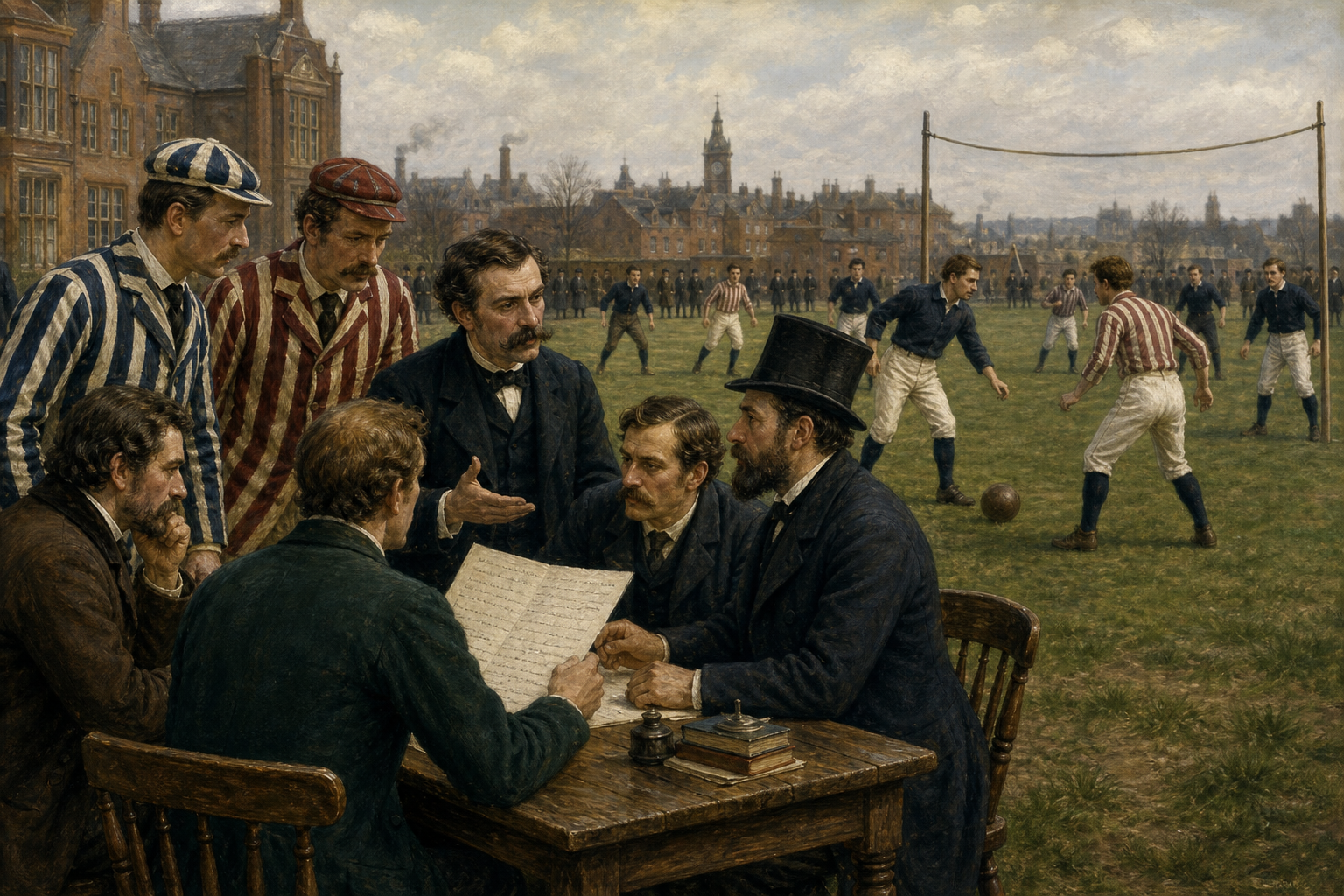
In October 1863, representatives from several London-area clubs met at the Freemasons’ Tavern. Their goal was practical: agree on one set of football rules. The group formed the Football Association, usually shortened to the FA.
Ebenezer Cobb Morley, a lawyer and sportsman, played a major role. He helped organize the meetings and drafted rules for discussion. The representatives did not agree easily. They met several times and argued about questions that would decide the game’s future.
Could a player run while holding the ball? Could opponents kick a player in the shins? Should the game reward carrying or dribbling? In the final FA rules, running with the ball in the hands and “hacking” opponents were left out. Some clubs disagreed and followed a different path. Over time, this split helped association football and rugby football become separate sports.
Why “soccer” and “football” are both correct
The formal name was association football. British students enjoyed shortening words and adding “-er.” “Association” became “assoc,” and then “soccer.” The nickname was British before it became especially common in countries where “football” could mean another sport.
So there is no need for a language fight. “Football” is the world’s most common name. “Soccer” is also a real historical nickname for association football. They describe the same game.
The laws keep improving
The 1863 rules were only a beginning. Goal dimensions, throw-ins, corners, free kicks, penalties, offside, referees, and match length developed over time. The Sheffield clubs had useful rules of their own, and different traditions slowly merged.
The first FA Cup began in 1871. In 1872, Scotland and England played what is widely recognized as the first official international football match. It ended 0–0, which proves that even historic matches can have no goals.
In 1886, the football associations of England, Scotland, Wales, and Ireland created the International Football Association Board, or IFAB, to protect and update the Laws of the Game. IFAB still has that job today, with FIFA also represented in the decision-making process.
Big lesson: Soccer was not frozen in 1863. The game became global because its basic idea stayed simple while its laws could be carefully improved.
Chapter 4: From Local Clubs to the World Cup
Factories, railways, and Saturday matches
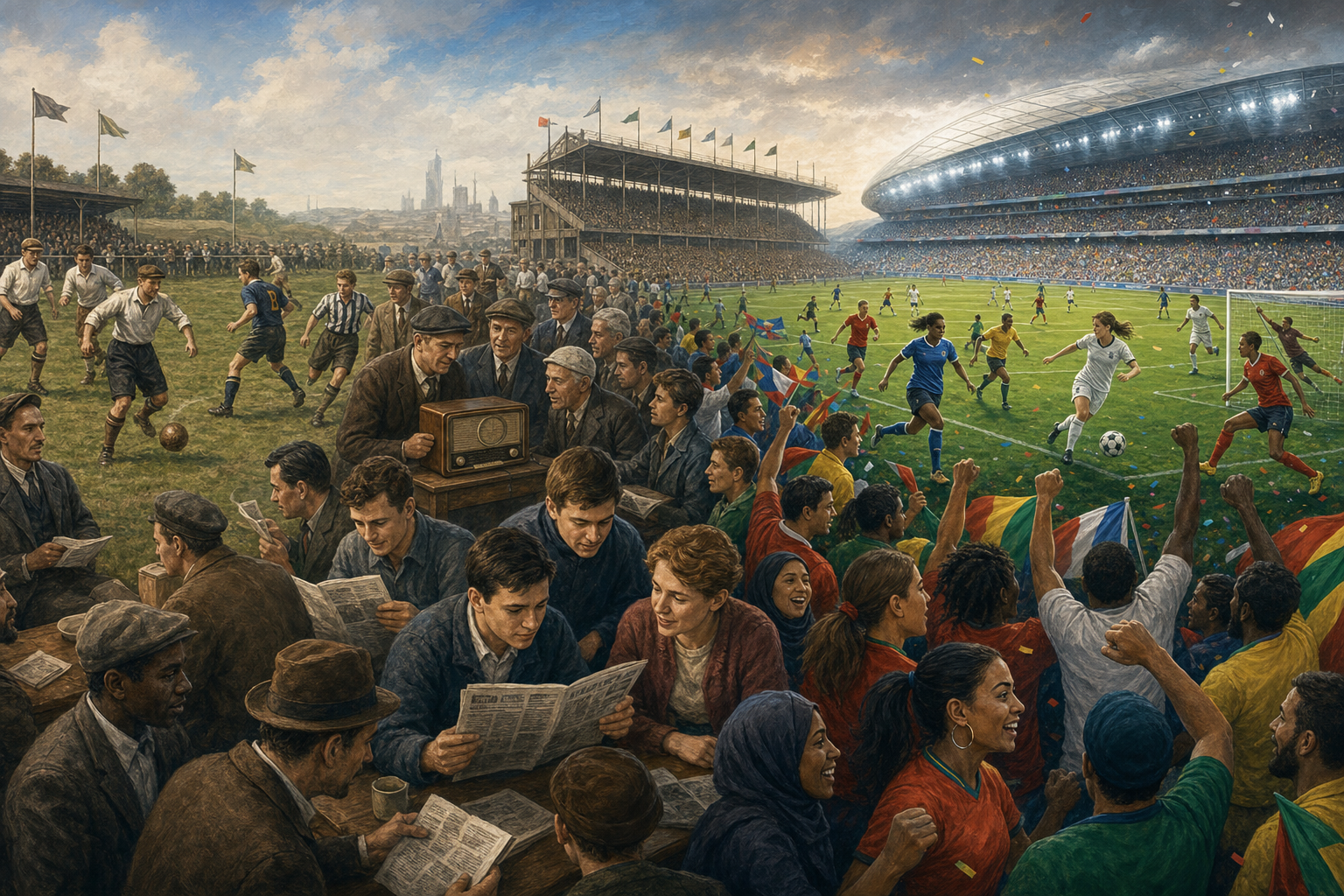
During the Industrial Revolution, cities grew quickly. Workers formed clubs through factories, churches, schools, and neighborhoods. Railways made it easier for teams and fans to travel. Newspapers printed results. Regular free time on Saturday afternoons helped matches become part of working-class life.
At first, many leaders wanted players to remain amateurs. But good players needed time to train and travel, and some clubs secretly paid them. The FA allowed professionalism in 1885. In 1888, twelve clubs created the Football League, giving teams an organized season of home and away matches.
British sailors, engineers, merchants, teachers, and workers carried the game abroad. Local players did not merely copy it. They built their own clubs, styles, rivalries, and traditions across Europe, South America, Africa, Asia, the Middle East, and beyond.
FIFA and a world tournament
In 1904, football representatives in Paris founded FIFA to help organize the international game. Football also became an important Olympic sport. But leaders wanted a separate tournament in which national teams could compete for a world title.
The first men’s World Cup took place in Uruguay in 1930. Travel was difficult and expensive, so only thirteen teams participated. Uruguay won the final against Argentina. The event was much smaller than today’s tournament, but the idea was enormous: one competition for teams from different continents.
Radio turned players into voices and legends. Newsreels brought moving pictures to cinemas. Television later carried matches into living rooms. A brilliant goal could suddenly be seen far beyond the stadium. Stars became international names, and children copied their moves in streets and schoolyards.
Women played—and fought to keep playing
Women’s football has a long history too. Women played organized matches in Britain during the late 1800s. During the First World War, factory teams grew popular while many men were away. Dick, Kerr Ladies became famous and attracted huge crowds.
Then, in 1921, the English FA stopped women’s teams from using grounds controlled by FA clubs. Officials claimed football was unsuitable for women. The restriction damaged the women’s game for decades, but it did not erase it. Players kept forming teams and organizing matches.
The English ban was lifted in 1971. International women’s football expanded, and the first official FIFA Women’s World Cup was held in 1991. Today, women’s matches fill major stadiums and produce global stars. The struggle is an important reminder: sports history is not only about winners. It is also about who was allowed onto the field.
Chapter 5: The Modern Game Never Stops Changing
Simple laws, endless possibilities
Modern soccer is played in glittering stadiums, on beaches, in refugee camps, on school playgrounds, and in narrow alleys. Expensive equipment can help, but the basic game asks for very little: a ball, some space, and an agreement about the goals.
That simplicity creates freedom. A team can defend deep and counterattack. It can keep the ball with short passes. It can press high, cross from wide areas, or build around one creative player. The field is large, goals are rare, and one moment can change everything.
Rules react to new problems
The laws continue to change. Yellow and red cards appeared at the 1970 World Cup, giving referees a clear visual language. Substitutions became normal. In 1992, goalkeepers were stopped from picking up a deliberate back-pass from a teammate, which encouraged faster and more attacking play.
Goal-line technology can tell whether the whole ball crossed the line. Video assistant referees, known as VAR, can review certain major decisions. Technology may reduce some mistakes, but it also creates fresh debates about delays, tiny offside margins, and what “clear and obvious” really means.
A game can unite—and reveal problems
Soccer gives people shared memories. Fans sing together. Families pass down club traditions. A national team can make millions of people feel connected for ninety minutes. Players from small towns can become heroes around the world.
But soccer also reflects society’s problems. Racism, unfair treatment, corruption, unsafe crowds, gambling, extreme pressure, and the high cost of watching or playing can harm the game. Loving soccer does not mean ignoring these issues. Real fans can celebrate the beauty and still ask hard questions.
A quick timeline
- More than 2,000 years ago: Cuju is recorded in ancient China.
- 1314: Edward II complains about football in London.
- 1848: Cambridge students write influential shared rules.
- 1863: The Football Association forms in London.
- 1871: The first FA Cup competition begins.
- 1872: Scotland and England play the first official international match.
- 1885: Professional players are permitted in England.
- 1888: The Football League begins.
- 1904: FIFA is founded.
- 1930: Uruguay hosts and wins the first men’s World Cup.
- 1991: The first official FIFA Women’s World Cup is held.
- Today: Soccer is played and followed in nearly every part of the world.
The final whistle—or the next kickoff?
The history of soccer has no final chapter. New players enter the game every day. New tactics appear. Women’s leagues grow. Smaller nations surprise famous teams. Fans find new ways to watch, discuss, and even play digital versions of the sport.
The next time you see a ball roll across a field, remember what is behind it: ancient skill games, village chaos, school arguments, Victorian meetings, railway journeys, factory teams, radio voices, banned women who kept playing, and generations of children making goals from whatever they could find.
And now the question comes to you: Which part of soccer’s history surprised you most—and what do you think the game should become next?